

Captain Jack Andrews also contributed to this article.
When the first legal U.S. online gambling sites went live in 2013, we were promised that the industry would support strong responsible gambling (RG) protocols. A united front that combatted the perils of problem gambling was supposed to be yet another way that regulated sites differentiated themselves from offshore competitors.
That didn’t pan out.
Instead, RG has proven an area in which the legal industry has failed: Not in its totality, but enough to where responsible gaming practices are in need of serious reevaluation and reform.
What we have today is a mish-mosh of incomplete tools that are inconsistent from site to site, and often hidden so deeply behind the scenes that most players don’t know they exist. Instead, “Deposit” icons and marketing campaigns promising outlandish riches to those who make even more outlandish wagers litter online casino and sportsbook homepages.
Two million U.S. adults meet the standards for severe gambling problems each year, and millions more are teetering on the edge. Problem gambling prevalence is higher among those who either gamble exclusively online or mix their play between live and online, and even higher for those who participate in multiple forms of gambling.
Based on these statistics, markets like NJ and PA, which offer multiple online poker, casino, and sports betting outlets are ripe fruit for problem gamblers. And with the launch of more multi-market verticals right around the corner (here’s looking at you Michigan), it’s high time for change.
1) Move Responsible Gaming tools to the forefront
To their credit, just about every regulated iGaming site displays a teensy-tiny RG icon on their homepage. Can you find it?

What’s green, about 40px wide, and blends in with the site?
From there, players can read about the ills and warning signs of problem gambling, and are instructed on how to seek help. There may even be a link to the responsible gaming limits page buried deep within the text. It’s all very nice, but the focus is on long-term recovery, and not on controlling gaming habits in the immediate.
Instead, online gambling sites need to offer direct access to responsible gaming tools that enable players to set limits, or to self-ban for a period of time. Every single iGaming site offers these options, but they’re stuffed behind multiple menus, sometimes four or five clicks away from the homepage.
Case in point: BetMGM.
To reach the limits page go to My Account — My Account (again) — Settings — Responsible Gaming — Responsible Gaming Limits. It’s all very intuitive, except not at all, and we wouldn’t expect anything less from one of the industry’s most predatory brands.
Our advice to regulatory bodies: Force sites to place RG tools at the forefront, with one-click access from the homepage and gameplay screens.
2) Empower players at the time of first deposit
Going further, why not inform players about responsible gambling options right out of the gate? Displaying a screen like the one shown below at the time of a player’s first deposit, or after they’ve reached a depositing threshold, would go a long way toward spreading awareness and would empower gamblers to take active control of their habits.
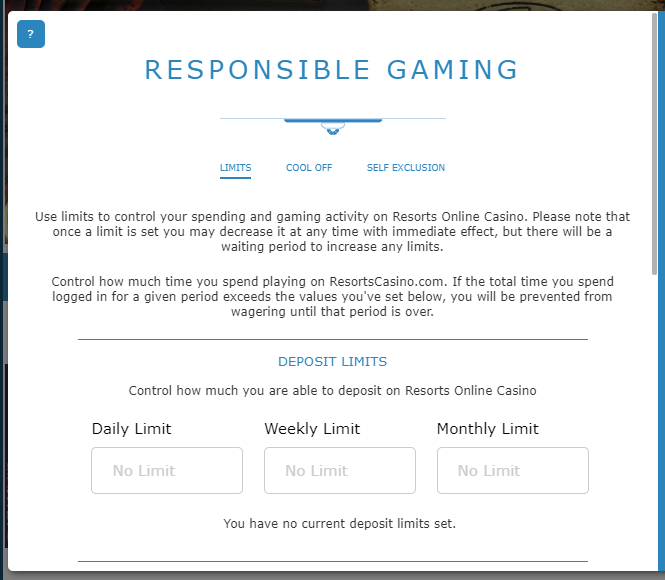 We realize there’s a fine line between helpfulness and intrusion, but most online gambling sites and sportsbooks stray far too far to the left of that line. Informing gamblers that they have options, and giving them the opportunity to take advantage of those options before they place their first real-money wager doesn’t feel like too great of an ask.
3) Eliminate pending withdrawals
Ever lock up a decent win, withdraw a portion of your winnings, lose the rest, and then wish you could get back to your high point?
Sure you have. Poker players sometimes refer to this as being “upstuck,” where you’re still up on the session but down from your apex.
Well, online gambling sites make it all too easy to chase. You see, once you withdraw, your funds will be stuck in a “pending” state, which basically means that the withdrawal request is recognized, but hasn’t been processed. During this time, players can reverse their withdrawal, and quite easily we may say.
Some sites do better than others here, processing payout requests within a day, or even within the hour. Others, and we’ll name Hard Rock Casino and DraftKings here as major culprits, will hold your money hostage for 3,4, even 7 business days. Caesars Casino is another site that leaves your withdrawal pending for an inordinate amount of time.
We suspect that this holding pattern is sometimes done by design, another predatory tactic by casinos to get you back on the virtual felt. There should be no reason for a casino to hold your funds in a pending state if you’ve already passed their customer identification checks and there are no anti-money laundering concerns. Unfortunately, many sites will hide behind their KYC (Know Your Customer) and AML (Anti-Money Laundering) duties to give you time to rethink your decision to reverse your withdrawal.
Players should be given the option to have their withdrawals locked up immediately, even if they’re in pending status. Not only would this prevent reckless gambling, but we suspect that the entire withdrawal process would be expedited.
4) Offer more flexibility
The extent of responsible gambling tools varies widely from site to site. Frankly, it’s all over the freakin’ map.
At the bare minimum, this is what you’ll find:
- Deposit limits (daily, weekly, monthly)
- Spending limits (daily, weekly, monthly)
- Time limits (daily)
- Self-suspension and self-exclusion
But the self-suspension options vary widely, with some sites allowing players to cool-off between 3 and 30 days in increments of one day, and others opting for weekly increments. Furthermore, online gambling sites in Pennsylvania mandate that players be able to set wagering limits, but this tool doesn’t exist on most sites in other states. It all feels very sloppy and uncoordinated.
Worst of all is that most sites still don’t allow gamblers to pick and choose which gambling verticals they want to participate in. This issue wasn’t a massive deal a few years ago, but with the proliferation of legal sports betting, there are numerous brands operating in the U.S. that offer some combination of sports betting, casino gaming, and poker.
There’s an old adage that floats among pro sports bettors and poker players: “There’s no such thing as a winning player, since the bad players lose to the rake and the winners lose in the pit.” Let’s be real: Operators know this and openly encourage skillful players to dump their hard-fought winnings on blackjack, video poker, or slots.
By allowing players to select which games they want to play without restriction, and which ones they’d like to be cut off from, they’ll be safeguarded from making poor decisions.
PokerStars is a solid example of a site that gets this aspect of responsible gaming right, offering one of the most flexible tools we’ve seen on the market. Other operators should examine its model and considering implementation. Or better yet, regulators should mandate that all sites offer the same responsible gaming tools, that encompass single vertical exclusion.
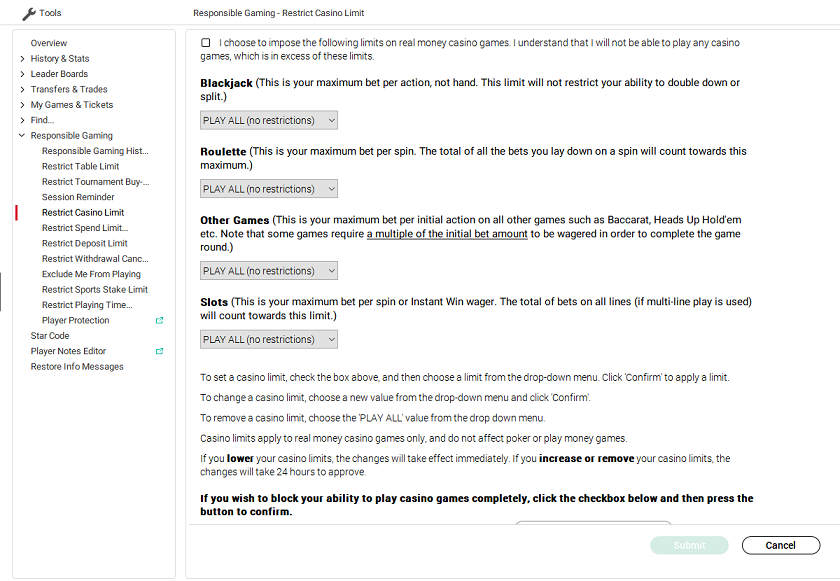
PokerStars allows players to restrict themselves by vertical, and by games within verticals. Amazing.
When it comes to responsible gaming: More is more.
5) Use data analysis to identify problem gamblers
The world of data science has come a long way and today’s casinos rely on data analysis to know what customers like, their behaviors, and to predict their future moves. They use this data to know the efficacy of promotional marketing and how to best present their web of gaming options. However, one area that has remained largely untouched by machine learning and data science is using it to identify problem gambling in real-time.
For more on machine learning and its relationship to gambling, follow Sharp Alpha Advisors Founder & CEO, Lloyd Danzig.
Problem gambling typically follows some very telltale signs.
- Deposits of increasing frequency and increasing size as players chase losses.
- Wager sizes that increase beyond typical norms for that player.
- Wagers on long-shots or parlays to attempt to get back to even.
It is a spiral that all gamblers find themselves in at one time or another. Chasing losses is one symptom of problem gambling that can be identified with data.
Currently, online casinos in NJ only hurl two speed bumps at gamblers. One, when your aggregate deposits for an entire year exceed $2500, you are given a pop-up to acknowledge such. Two, a pop-up will flash based on the amount of time you’re playing, usually in one-hour increments. These are not speed bumps, they’re speed humps: The kind you can roll over at 20 mph with no issues.
What is needed are the speed bumps where you best come to a complete stop or else you’ll be taking your car in for some serious wheel repairs. Make a user acknowledge that their actions are similar to known actions of problem gambling. Even something as simple as a 5-minute countdown between deposits could be beneficial to someone who is compulsively re-depositing to chase a frustrating loss.
Maybe it’s an oversimplistic view, but if gambling operators have algorithms sophisticated enough to recognize and limit sharp sports bettors, then they certainly have the capacity to flag potential problem gamblers.
6) Universal timeouts
The rapid expansion of online gambling in the United States is great for bettors looking to line shop. Not so much for those with gambling problems.
Imagine a scenario in which a player realizes they are starting to develop a gambling problem, and makes the wise decision to self-suspend for two weeks from all gambling activity. Luckily, all regulated sites allow players to do this (pending they can actually find the often buried “self-suspend” option). However, in order to eliminate any temptation, they’re going to have to self-suspend not from one, not from two, but from up to dozens of different sites.
For instance, let’s say my main out is FanDuel Sportsbook. I self-suspend from there for 14 days and am feeling good about my decision. Three days pass and there’s a tempting line on a Bulgarian table tennis match. Well, I can’t place that wager on FanDuel, but there’s always DraftKings, Fox Bet, or countless other sites. What happens next is I either place the bet at one of these sites, or make the painstaking decision to go through every single sportsbook that legally operates in my state, and self-suspend from them as well. What a hassle.
Instead, wouldn’t it make sense for sites to offer an option to self-suspend from all iGaming sites for the specified period? Yes, self-exclusion accomplishes that, but the minimum period is one-year, and many gamblers don’t need that long to get their heads screwed on right.
The same applies to promotional emails. Innumerable amounts of time and energy are spent tempting losing players, be it via a bonus that encourages more gambling, or language that suggests good fortune is in the cards. Some marketing emails are so blatant, that operators will openly ask you to keep gambling or you’ll be “missing out on VIP treatment”. Trust us, these VIP experiences are not what they’re cracked up to be, and the cost is high.
Gamblers should have the option to pull the plug on all promotional materials for a specified time. Yes, players can unsubscribe from emails, but when they’re registered with 20 different iGaming sites, that’s not as easy as it sounds.
Instead, there should be a specific responsible gaming tool that removes players from all email, text, or phone campaigns. Some of the industry’s better sites, like Play SugarHouse, already have good tools in place, but they only apply to one individual site.
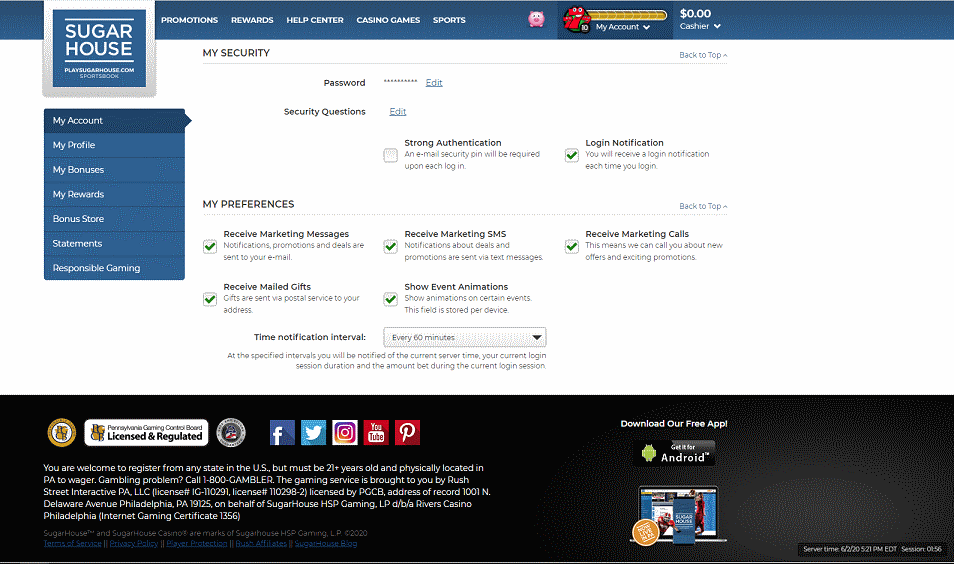
This is good practice.
By enabling “across the board” responsible gaming protocols, players will be more equipped to curtail their gambling demons, without having to make a year-long commitment.
